 ®
®Process severity
Record the welding or cutting process, spatter pattern and exposure duration.
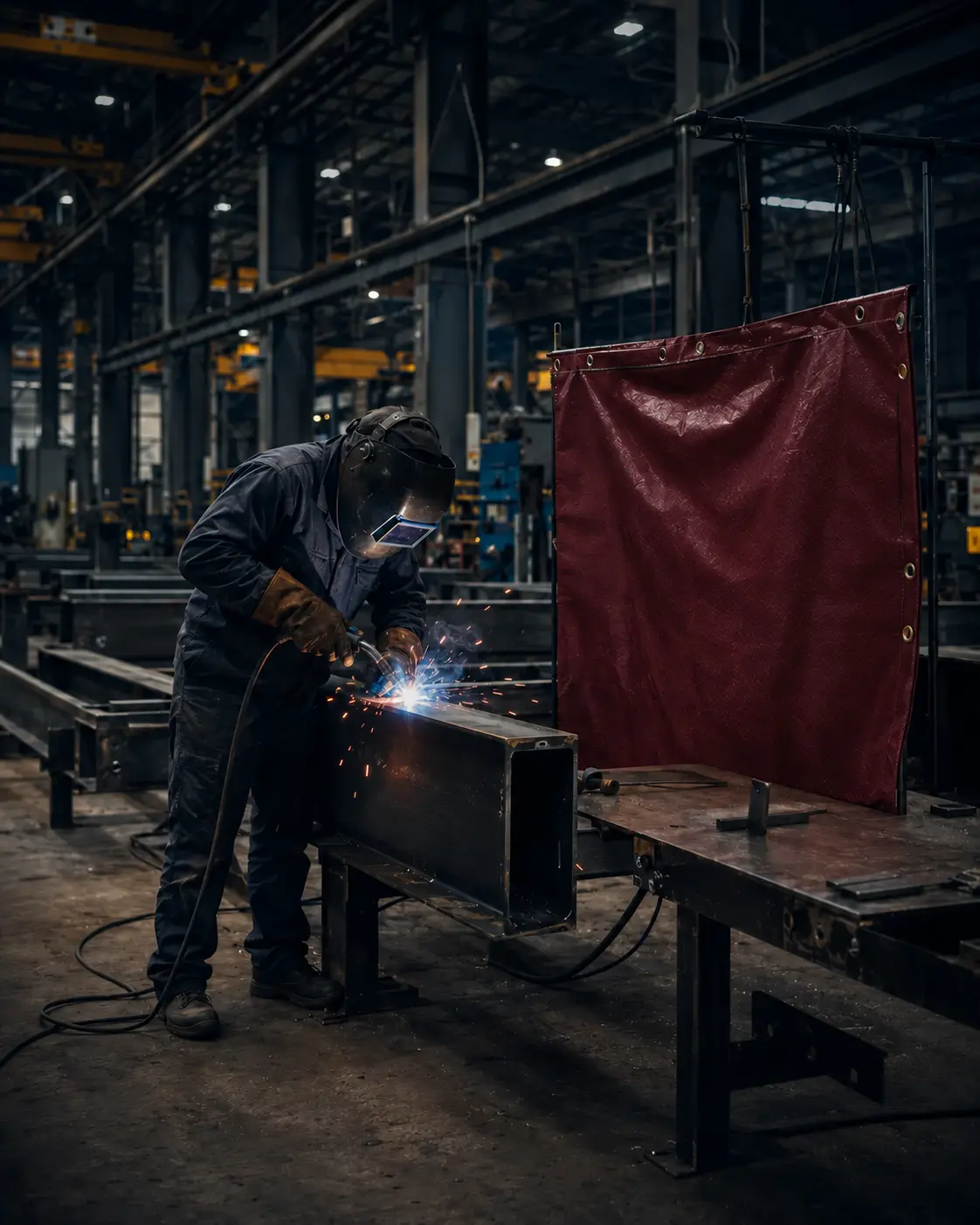
03 / Fabrication welding protection
Fabrication environments reward repeatable setups. The right system should match the process, spatter, orientation and handling cycle while remaining practical for operators to place, inspect and replace.
Application first
A permanent welding cell, a mobile repair bay and a finished-floor work area have different needs. Standardize the selection inputs—process, exposure, distance, orientation, coverage and replacement criteria—before standardizing the product.
Selection inputs
Record the welding or cutting process, spatter pattern and exposure duration.
Define curtain, drape, pad and floor-protection zones separately.
Choose formats that can be placed, moved and inspected safely during normal production.
Set inspection and retirement rules appropriate to the exposure and condition.
Product relationships
Use the actual fabrication process and work-cell layout to confirm the system. Current product-specific documentation remains the final reference.
A lighter coated starting point for routine fabrication, maintenance and easier positioning.
View the product ↗02Alpha®A heavy-duty option for heavier spatter, abrasion and repeated handling.
View the product ↗03Precut Alpha® BlanketsFinished standard sizes for repeatable temporary cells and equipment coverage.
View the product ↗04Welding Pads & CushionsLayered protection for horizontal work and added insulation.
View the product ↗05Blue DiamondReusable FR and anti-static rated protection for compatible finished floors and work-zone surfaces.
View the product ↗Direct answers
Alpha is the heavier-duty starting point for more demanding spatter, abrasion and repeated handling. Beta is lighter and easier to position for routine fabrication and maintenance. Confirm the final choice against the real process and orientation.
Precut Alpha blankets suit repeatable coverage needs where finished edges, standard dimensions and corner grommets simplify placement. Roll goods may be more appropriate when coverage changes frequently.
Document the process, exposure, orientation, protected surface, required coverage, handling cycle and inspection criteria. Then tie each approved work-cell setup to a current product and document set.
Application review
Share the work-cell layout, process, exposure, current material and replacement pattern. Nische can help compare systems without adding unsupported specifications.
Review a fabrication application